
With new EU requirements, both large and medium-sized Danish wastewater treatment plants face a technological leap. Ozone treatment has proven highly effective at removing micropollutants, and with the Gaia ozone generator from Water ApS, the solution is scalable, energy-efficient, and Danish-made.
When the revised Urban Wastewater Directive (EU directive on wastewater treatment) comes into force, plants across the country must significantly upgrade their treatment processes. By 2045, an 80% reduction of 12 key indicator substances is required – pollutants that today contribute to the poor chemical status of aquatic environments. The requirements apply not only to the largest facilities but also to medium-sized treatment plants
with capacities as low as 10,000 PE, especially when they discharge into sensitive areas.
According to the Danish Environmental Protection Agency’s report Treatment Train (a national study evaluating advanced treatment technologies for micropollutant removal), ozone has proven to be one of the most effective methods for breaking down pharmaceuticals and industrial trace substances. Pilot studies have documented very high removal rates of unwanted substances, including compounds that are otherwise difficult to reduce with conventional methods. This means that Danish utilities are facing an important technological choice when making large-scale investments in new treatment processes.
“Denmark doesn’t only have large treatment plants, there are also around 800 medium-sized plants that, by 2045, must be able to remove more types of micropollutants. Many of them discharge into fragile aquatic environments with low dilution capacity, which increases the need for advanced treatment,”
says Katerina Spiliotopoulou, researcher in advanced water treatment.
Why Ozone works
Ozone works by attacking the chemical bonds in organic pollutants, breaking them down through a strong oxidation process. A major advantage is the speed: treatment typically takes only a few minutes. In facilities with limited space, the Gaia Ozone System can be integrated directly into existing pipelines, reducing the need for major construction work. Ozone is an extremely reactive gas that degrades micropollutants and organic compounds in wastewater. Unlike many other oxidants, such as chlorine, ozone quickly breaks down into pure oxygen and CO₂. This makes it highly suitable when stricter treatment requirements demand well documented results.
In practice, ozone functions as a “chemical-free cleaning agent”: it is generated on site, reacts with the pollution, and then disappears again. This results in both high treatment efficiency and a low environmental footprint. Experience from Switzerland shows that ozone can reduce pharmaceutical residues by more than 80% when the process is properly managed.
“Ozone is one of the technological tools we know works broadly on many micropollutants. It has great potential in Denmark, where the requirements will become even more ambitious in the coming years,” adds Katerina Spiliotopoulou, Project Manager & Senior Scientist.
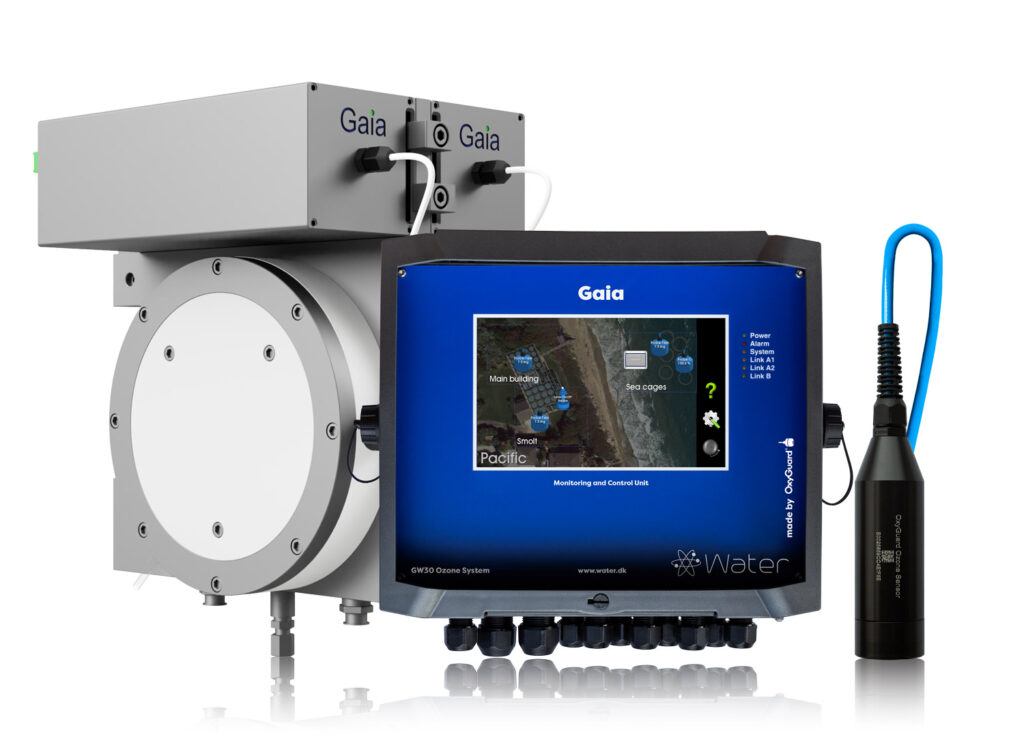
Smart and compact Danish treatment with the Gaia Ozone Generator
The Gaia system can be adapted to both small and large plants and scaled up if treatment requirements change in the
future. It can run fully automatically, but also allows manual adjustment if operating conditions vary.The built-in monitoring system gives operators a clear picture of when and how ozone treatment is most effective, helping further optimize energy use. Although ozone treatment has been known for decades, it was previously associated with large facilities and high energy consumption. With the Gaia ozone generator, Water ApS has made the technology simple to implement, also for small and medium-sized treatment plants.
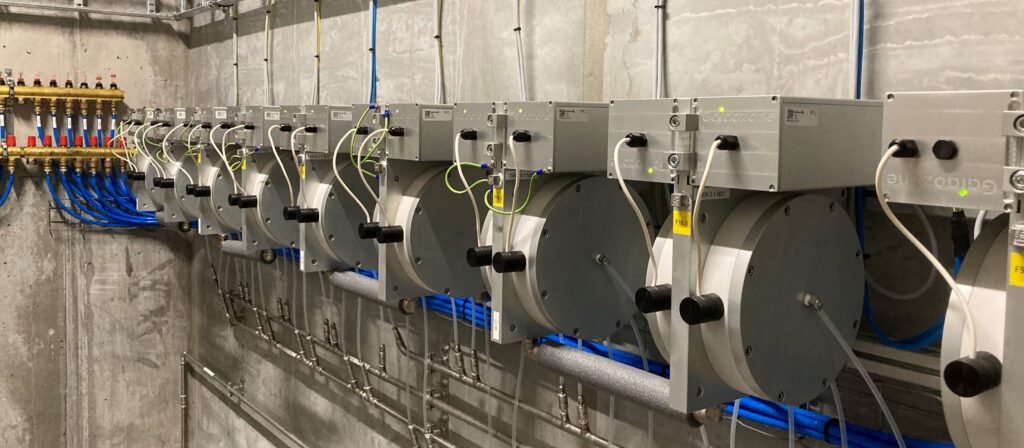
Gaia is modular, with compact units that can be placed directly at the plant. The short distance means the ozone does not degrade during transport, and energy consumption is not only kept low but actually reduced by more than 30% compared to other known methods.
Capacity can be tailored by linking multiple modules together. Gaia is based on patented Danish technology, developed with a focus on reliability, flexibility, and high ozone concentration relative to energy use. Its design has been refined over many years of research and innovation, providing utilities with confidence in long-term operation. The unique system is not available anywhere else.
A key part of the solution is integration with OxyGuard’s monitoring and control systems, where ozone concentration and operations are tracked in real time. This ensures treatment efficiency is documented and workplace safety is maintained. The combination of smart control, reliable data, and high treatment performance makes Gaia an obvious choice for utilities aiming to stay ahead of the new requirements.
Four steps to Clean Wastewater
An important aspect of effective wastewater treatment is looking at the entire process line. Ozone treatment is typically one step in a multi-stage system.
In the recommended four-step model, the process starts with mechanical treatment that removes larger particles, followed by biological treatment where microorganisms degrade organic matter. Next comes ozone treatment, which effectively reduces pharmaceuticals and other micropollutants. Finally, a filtration step ensures that even the smallest particles and residues are removed.
This combination delivers a high overall purification level, making it possible to meet even the strictest requirements.
Research and Green Transition Go Hand in Hand
Experiences from abroad show that when ozone is combined with other treatment steps, not only is the overall purification rate high, but discharges of substances that can disrupt hormones or harm aquatic ecosystems are significantly reduced. This is crucial to meeting future EU goals of protecting both drinking water and ecosystems.
Water ApS continuously works to document the effects of its solutions, giving Danish utilities a solid foundation for choosing the right technologies.
For more than 30 years, Water ApS has specialized in advanced water treatment technologies, collaborating with research institutions and advisors to develop tomorrow’s solutions. The company participates in projects under the Danish EPA and in partnerships with DTU, where experiences from different treatment approaches help strengthen the entire industry.
With the many upcoming investments in treatment plants, there is a unique opportunity to choose solutions that combine proven effectiveness, energy efficiency, and operational reliability.
Water ApS delivers complete plants but also provides support for design, documentation, integration, and operation.