
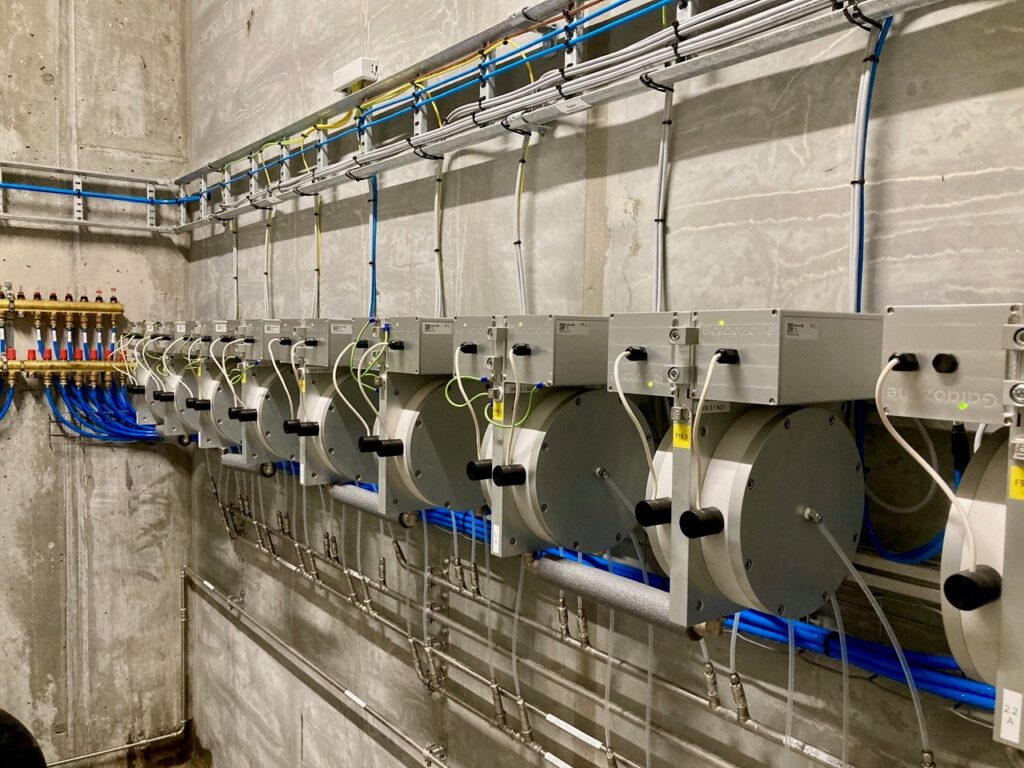
Water ApS has delivered a large ozone system to Skagen Salmon.
Operational experience from this installation has been an important step in the development of efficient and safe ozone solutions for aquaculture and water treatment in general.
The project has provided valuable experience in integrating a large system with the Gaia Ozone Generator to achieve efficient and stable operation in a Recirculating Aquaculture System (RAS).
The focus has been on optimizing the balance between capacity, operational reliability and control, ensuring that the system performs consistently and efficiently in daily production over time.
“When operating at larger scale, the requirements for stability and control become even higher. It has therefore been essential to ensure a solution where the system capacity matches the requirements for safe and stable operation,”says Richard Martin, Water ApS.
In RAS facilities, it is essential that the ozone gas is fully dissolved in the water. For occupational safety and environmental reasons, ozone must not escape into the surrounding environment. At the same time, the system must be correctly dimensioned to ensure that production matches demand and unnecessary overproduction is avoided.
Water ApS has continuously developed the Gaia ozone generator and today is among the few manufacturers capable of delivering ozone at a concentration of 10 percent (weight/weight) at a competitive price.
The experience gained from the collaboration with Skagen Salmon has helped strengthen and document this development.
“For us, it is about occupational safety, operational reliability and documented effect. The collaboration with Water ApS has given us insight into testing and the resulting optimizations that today support stable and efficient production in our RAS facility,” says Flemming Jensen, Skagen Salmon.
The project marks an important step in the continued effort to ensure stable and energy-efficient ozone solutions for the future of aquaculture.