

Ozone is a highly reactive gas, but new knowledge and technology show that when used intelligently, it can both remove muddy off-flavors in farmed fish, improve fish welfare, and make aquaculture production more sustainable.
By Lasse Polke-Pedersen (OxyGuard A/S), Jesper Heldbo (OxyGuard A/S), and Uffe Wilken (Scienceline.info)
Nobody likes the taste of mud — especially not if you sit in your favorite fish restaurant and your tastebuds are looking forward to the rich, buttery flavor of salmon, only to encounter an earthy off-flavor from the salmon when it hits your tongue. Resourceful fishermen and chefs have known for decades how to solve this problem: let the fish swim for a few days in clean water to flush out the muddy taste.
In principle, this is the same method many fish farmers use today to remove off-flavors from the thousands of tons of trout and salmon raised each year in recirculated land-based aquaculture systems around the world. The problem is that bacteria living in the recirculated water produce geosmin and 2-MIB — the two main compounds responsible for the muddy taste. Instead of spending just a few days in a tank, the fish often remain in large tanks for 5–14 days to ensure that the natural off-flavors are removed from the fish.
However, this method is far from optimal — neither for the fish, the environment, nor the farmer. During this period the fish are typically not fed, and the farmer may lose up to 5% of revenue because the fish lose weight and the production system must continue operating for a longer period. These costs are directly reflected in higher energy and water bills.
A Muddy Taste Without Mud
According to the Food and Agriculture Organization of the United Nations (FAO), more than half of the world’s fish consumption is now produced in aquaculture systems, either at sea or on land.
In the EU, policymakers are actively working to modernize the aquaculture sector through the Strategic Guidelines for a More Sustainable and Competitive EU Aquaculture (2021–2030). A key part of this strategy is the promotion of Recirculating Aquaculture Systems (RAS) — land-based, high-tech facilities that allow fish farming with minimal water consumption.
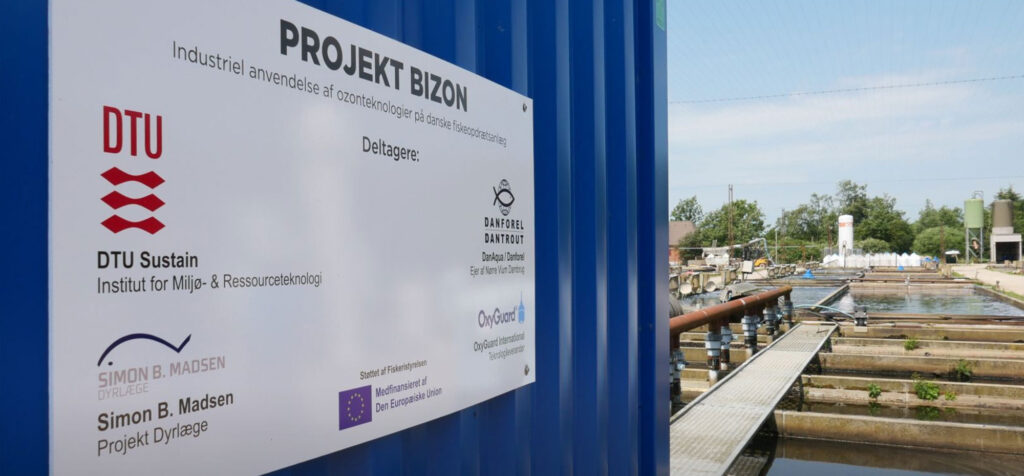
In Denmark, researchers from the EU-supported BIZON project have, during 2024 and 2025, investigated how ozone treatment can be optimized to improve water quality, remove geosmin and 2-MIB, enhance fish welfare, reduce energy consumption, and ultimately make aquaculture production more sustainable.
At first glance, it may seem surprising that fish from closed RAS systems — where water is continuously treated — can still develop muddy off-flavors. Adam Hambly, project leader of BIZON at the Technical University of Denmark (DTU), explains:
“Geosmin and 2-MIB are produced by different types of bacteria. Some bacteria enter the recirculating system from external sources, while others develop within the system itself.”
Hambly describes ozone as an almost universal water treatment tool, and the BIZON project has demonstrated that ozone effectively removes these off-flavor compounds. However, he adds an important caution:
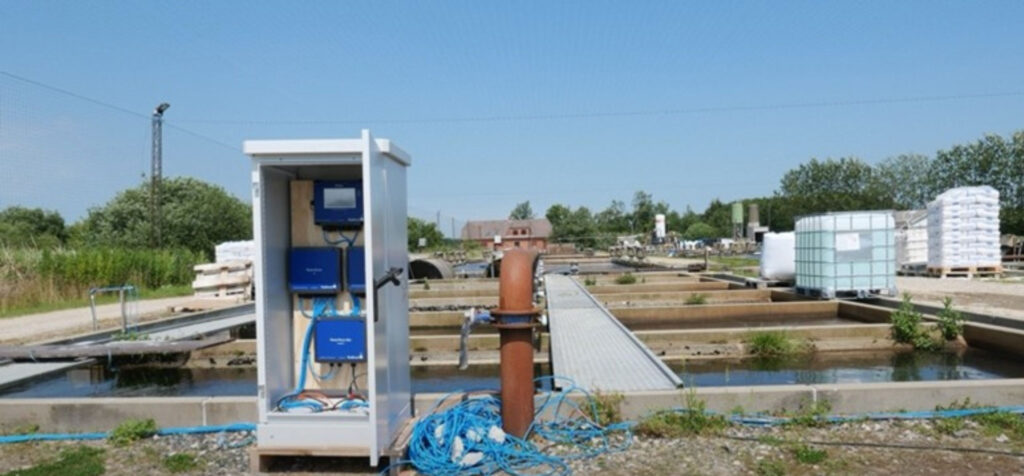
“You have to be careful. Ozone is so powerful that it can potentially harm the fish. The challenge is to find the right balance between overdosing and underdosing. That is why the project installed sensors and collected water samples throughout the system in order to continuously fine-tune the treatment.”
Water Treatment with Ozone Under Pressure
In Nørre Vium in western Jutland, not far from the North Sea, DanForel — a key partner in the BIZON project — produces 700 tons of trout annually using recirculated groundwater in a landbased facility.
For the past two years, industrial PhD researcher Lasse Polke-Pedersen from OxyGuard A/S and the University of Copenhagen has conducted a series of large-scale experiments at the DanForel fish farm. The goal has been to test how intelligent ozone application can remove waste compounds and off-flavors, improve fish welfare, and optimize water and energy use in commercial-scale production systems.
Using ozone for water purification is not new. What is new, however, is the way the ozone is dissolved into the water in Polke-Pedersen’s project. He explains:
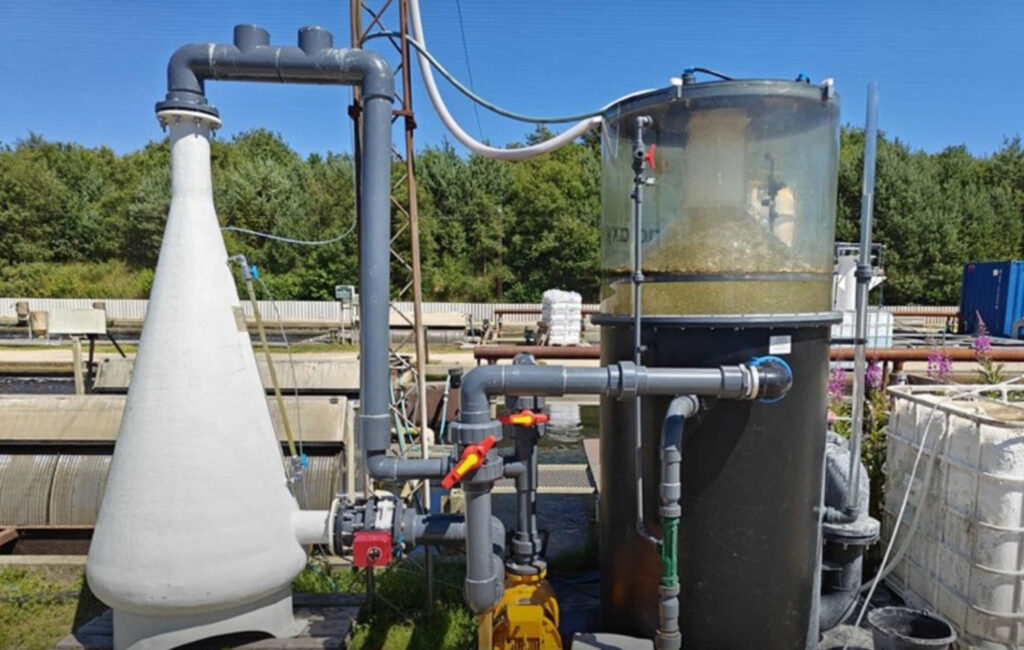
“Many facilities already use ozone for water treatment. What was new in our experiments was that we injected ozone under pressure through an oxygen cone into untreated freshwater. The pressure allows the water to dissolve more ozone, and because ozone is extremely reactive, we hoped to achieve more effective purification where ozone breaks down waste compounds, off-flavor substances, and the organic residues from fish and feed that geosmin-producing bacteria depend on.”
The ozone is generated on-site by passing oxygen through a high-voltage chamber. The ozone
is then directed into the oxygen cone, where it dissolves into the incoming wastewater.
At the same time, ozone concentrations were continuously monitored at multiple points in the system in real time, allowing precise automatic dosing according to demand. The monitoring and dosing system was based on sensors and algorithms developed by OxyGuard.
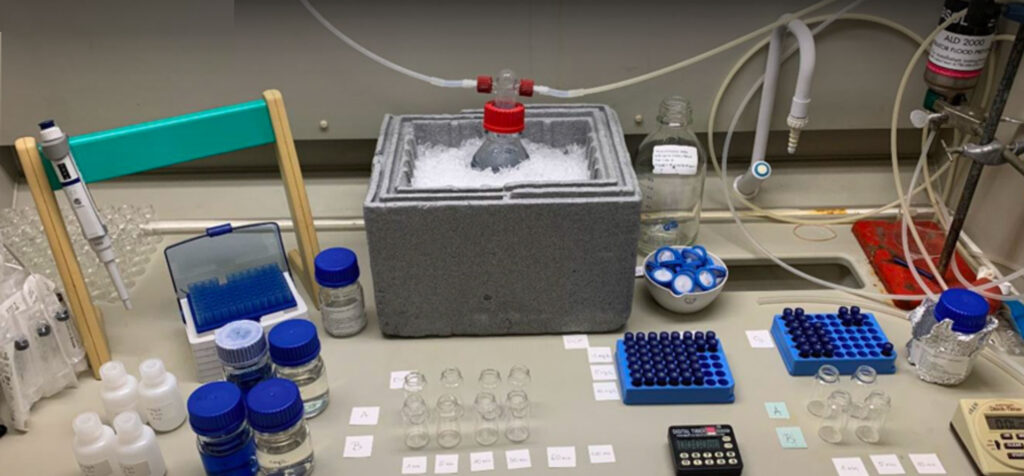
A wide range of parameters were continuously monitored, including O3 concentration, O2 flow rate, pH levels, and bacterial content. Additional water samples from the treated water were analyzed at DTU for TOC, dissolved organic matter (measured as FDOM), bacterial content (measured as BactiQuant), and geosmin concentration.
Polke-Pedersen tested and compared four commonly used water treatment methods in aquaculture systems: skimmer, Vacuum Air Lift (VAL), oxygen cone, and oxygen cone combined with skimmer. Wastewater from each method was treated with three ozone dosages: 0 mg/L, 1 mg/L, and 2 mg/L.
Regarding the experimental results, he explains:
“One of the traditional methods for removing waste from fish tanks is to collect the compounds as foam at the top of a water column in a protein skimmer. Air bubbles are passed through the water, and the waste compounds attach to the bubbles and form foam.
Compared with the reference systems, we found that when production water and the waste compounds in the foam were treated with ozone under high pressure, water purification became significantly more efficient than with other methods.
We observed a clear dose-response relationship: higher ozone dosing resulted in more effective treatment. Across all technologies tested, increased ozone dosing led to greater removal of organic matter and a stronger reduction in bacterial content.”
Less Geosmin Means Healthier Fish
One of the main objectives of the project was to identify a method that could prevent farmed fish from developing geosmin and 2-MIB off-flavors.
The problem is generally not relevant for fish farmed in open marine environments. However, saltwater fish raised in land-based RAS systems can still experience off-flavor problems, which are linked to the recirculating production systems. The new knowledge and technological developments are therefore expected to benefit this growing segment of aquaculture.
Because the bacteria producing these compounds thrive on organic waste in the tanks, it was essential to investigate whether improved purification also reduced off-flavor levels. Polke-Pedersen explains:
“The removal of geosmin followed the same dose-response pattern in most reactor types. Especially in the skimmer and the VAL unit, significantly more geosmin was removed as the ozone dose increased.
We removed 34% of the geosmin by adding ozone directly to a skimmer. But when the same ozone dose was added to an oxygen cone instead, and the ozone-enriched pressurized water from the cone was subsequently passed through a skimmer — effectively connecting the two technologies in series — we removed 74% of the geosmin.
In other words, we achieved a doubling of geosmin removal efficiency simply by combining the two technologies. Without ozone, we only removed 10–20% of the geosmin, depending on the technology used.
The experiments with controlled ozone dosing allow us to scale the system up in the future and potentially treat entire facilities effectively enough that fish no longer need several days of depuration before harvest. That could significantly reduce electricity and water consumption for fish farmers.”
The dramatic reduction in geosmin levels may also improve fish welfare — something Polke-Pedersen documented in a scientific article published in January 2026. He explains:
“It is generally assumed that around 90% of the water in RAS facilities is recirculated water, meaning only 10% is new water. If the incoming water comes from clean groundwater sources, as in Nørre Vium, this is not a problem. But if the water comes from rivers or streams, it naturally contains microorganisms — including pathogenic viruses and bacteria that produce undesirable taste and odor compounds.
Removing geosmin and 2-MIB from the water improves fish welfare because these compounds suppress the fishes’ immune systems. Healthier fish are less susceptible to disease, meaning farmers can reduce spending on medication, lower mortality rates, and ultimately produce more and larger fish for sale.
Overall, the BIZON experiments in 2024–2025 demonstrated that ozone significantly reduces unwanted substances in aquaculture water, although with some week-to-week variation depending on operational conditions. This highlights the importance of continuously fine-tuning ozone control and monitoring water quality — precisely what the project’s sensors and algorithm system is designed to do.”
Saving Energy, Reducing Costs, and Improving Sustainability
Ozone is already used in many RAS facilities worldwide. However, current systems also face energy-related challenges. Polke-Pedersen explains:
“In conventional ozone systems, money is first spent producing ozone, and then additional money is spent destroying excess ozone because it is hazardous to the surroundings. Ozone destruction requires energy and represents a significant operating cost.
Today, residual ozone is typically directed from the skimmer to a so-called destructor, which converts O3 back into O2. But this setup is inefficient because the ozone quickly degasses due to the intense turbulence, and the gas must then be collected and destroyed.
We optimized the process by placing the oxygen cone with overpressure before the skimmer. This ensures that all ozone is dissolved before the water enters the skimmer, eliminating waste. When the pressurized water exits the oxygen cone, the pressure drops and bubbles form — much like opening a bottle of soda. These bubbles are then used to collect waste compounds at the top of the skimmer before being removed from the system.
If we can still detect ozone in the treated water, it means we are either overdosing or there is insufficient organic material for the ozone to react with. Because we monitor ozone concentrations in real time, our control system automatically adjusts the ozone dosage to match actual conditions.”
Intelligent and optimized ozone use improves fish welfare, conserves water and energy resources, reduces environmental impact compared with traditional RAS systems, and simultaneously improves the economic performance of fish farming operations.
And perhaps most importantly — fish taste of fish.